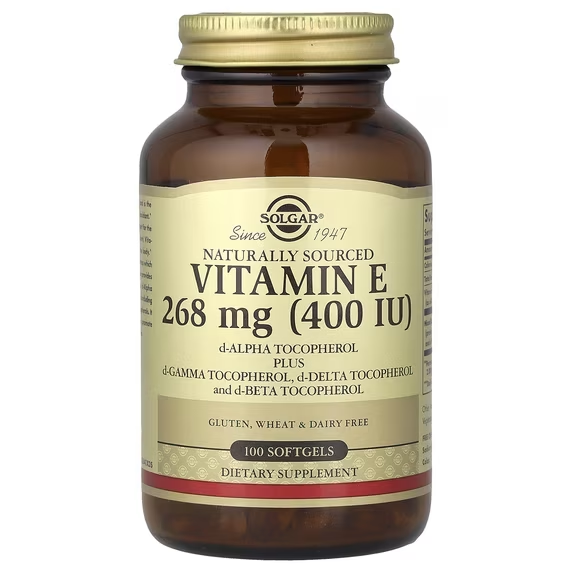

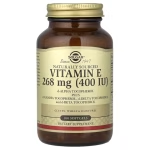

Solgar Natural Vitamin E 400 IU Softgel Capsules — Premium Full-Spectrum Antioxidant for Skin, Heart and Cellular Protection


Hotline Order:
Mon - Sat: 08AM - 09PM
+923228998756
Solgar. Seventy Years of Getting It Right.
There are supplement brands that spend heavily on marketing. Then there are brands that spend heavily on science. Solgar, founded in New York in 1947, has spent seventy-six years in the second category — quietly producing some of the most respected, practitioner-recommended formulas in the American supplement industry, sold in specialist health stores rather than mass-market retail chains.
When Solgar formulates a Vitamin E product, the choices made are deliberate and uncompromising. Natural source. Full-spectrum tocopherols. Softgel delivery for maximum fat-soluble absorption. No synthetic fillers, no artificial anything.
This is what premium looks like when the premium is real.
Natural vs. Synthetic Vitamin E — A Distinction That Actually Changes Outcomes
Walk into any pharmacy in Pakistan and the Vitamin E capsules on the shelf almost certainly contain dl-alpha-tocopherol — the synthetic form produced through petrochemical processing. It is cheap, stable, and widely available. It is also measurably inferior.
Here is the biochemistry behind that claim.
Natural Vitamin E exists as d-alpha-tocopherol — a single, biologically active stereoisomer. Synthetic Vitamin E is dl-alpha-tocopherol — a racemic mixture of eight different stereoisomers, only one of which (the d-alpha form) is recognized and utilized by human tissue. The remaining seven forms are either weakly active or biologically inert.
Research published in the American Journal of Clinical Nutrition demonstrated that natural-source Vitamin E achieves tissue concentrations approximately twice as high as an equivalent IU dose of synthetic Vitamin E. Put simply: 400 IU of natural Vitamin E delivers the biological activity of roughly 800 IU of the synthetic version.
Solgar uses exclusively natural-source d-alpha tocopherol. Every softgel.
What Vitamin E Actually Does Inside Your Body
Membrane Guardian
Every single cell in the human body is enclosed by a phospholipid bilayer — a membrane constructed largely from fatty acids. These fatty acids are inherently vulnerable to oxidative damage from free radicals generated by pollution, UV radiation, metabolic byproducts, and chronic inflammation.
Vitamin E is the body's primary fat-soluble antioxidant, positioned precisely within these fatty membranes. It intercepts free radicals before they can initiate lipid peroxidation chain reactions — the process that progressively damages cell membranes, accelerates cellular aging, and impairs organ function over time.
No water-soluble antioxidant, including Vitamin C, can perform this function. They operate in different biological compartments. Vitamin E's territory is the lipid environment — cell membranes, LDL cholesterol particles, skin tissue lipids, myelin sheaths surrounding nerve fibers.
Cardiovascular Relevance
LDL cholesterol becomes dangerous primarily when it is oxidized. Oxidized LDL triggers the inflammatory cascade that leads to arterial plaque formation and atherosclerosis. Vitamin E, embedded within LDL particles, protects them from oxidation — reducing the substrate available for the inflammatory process that drives cardiovascular disease.
This is particularly relevant in the Pakistani context, where cardiovascular disease rates are among the highest in South Asia and dietary antioxidant intake from fruits and vegetables frequently falls below optimal levels.
Skin Architecture from the Inside
Pakistani skin faces a dual assault: intense UV radiation from a near-equatorial sun and particulate matter pollution in every major urban center. Both generate reactive oxygen species that damage skin lipids, degrade collagen, and accelerate the visible signs of aging.
Oral Vitamin E supplementation addresses this at the cellular level — rebuilding antioxidant reserves in skin tissue that topical products cannot reach. Clinical studies have shown measurable reductions in UV-induced skin damage markers following consistent oral Vitamin E supplementation over eight to twelve weeks.
Supplement Facts
| Nutrient | Amount Per Serving | % Daily Value |
|---|---|---|
| Vitamin E (as d-alpha Tocopherol, Natural Source) | 400 IU (268 mg AT) | 1,787% |
Serving Size: 1 Softgel Capsule Servings Per Container: 100
Other Ingredients: Soybean Oil, Gelatin Capsule, Glycerin, Water, Caramel Color
Free from artificial colors, flavors, sweeteners, preservatives, sugar, starch, corn, yeast, wheat, gluten, soy protein, dairy, and sodium — consistent with Solgar's longstanding clean-label commitment.
The Solgar Manufacturing Standard — Why It Matters for Pakistani Importers
Pakistan's supplement import market has a quality consistency problem. Products arrive from various sources, and without understanding the manufacturing standard behind a brand, consumers cannot easily distinguish genuine quality from convincing packaging.
Solgar manufactures exclusively in facilities that meet or exceed United States FDA Current Good Manufacturing Practice regulations. Every batch undergoes identity testing, potency verification, and contamination screening before release. The company maintains a policy of not using unnecessary excipients — if an ingredient is not contributing to the product's function or stability, it is not in the capsule.
For Pakistani consumers investing in imported supplements, Solgar represents one of the lowest-risk premium brands available — a company with a seven-decade track record and no history of major quality scandals or recall events.
Directions for Use
Take one softgel capsule daily with a meal. Fat-soluble vitamins — including Vitamin E — absorb significantly better when consumed alongside dietary fat. A meal containing eggs, full-fat dairy, cooking oil, nuts, or avocado provides sufficient fat for optimal absorption. Avoid taking on an empty stomach.
Individuals using prescription anticoagulant medications such as warfarin should consult their physician before beginning Vitamin E supplementation, as Vitamin E at 400 IU has mild antiplatelet properties that may interact with anticoagulant therapy.
Add your review
Your email address will not be published. Required fields are marked *
Please login to write review!
Looks like there are no reviews yet.
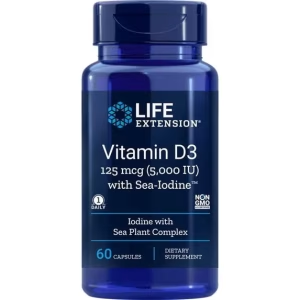
Life Extension, Vitamin D3 with Sea-Iodine™, 60 Capsules
₨7,000 ₨7,000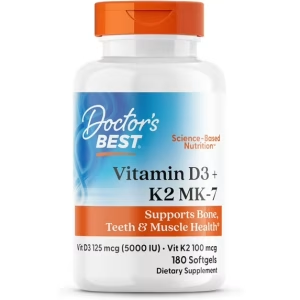
Doctor's Best, Vitamin D3 + K2 MK-7, 180 Softgels
₨13,000 ₨13,000